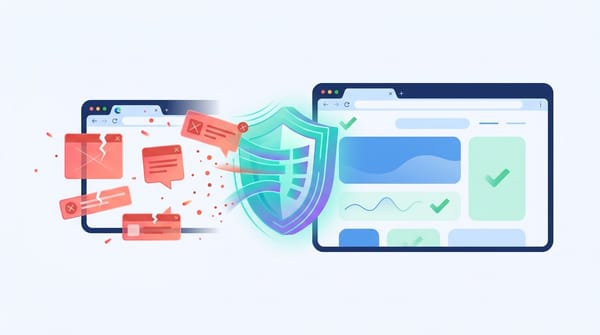

When you type a website name into your browser, your device asks a directory where to find it. This is a DNS lookup. Historically, almost all of these lookups happened in plain text, meaning anyone on your local network could see exactly which sites you were requesting.
Private DNS encrypts that initial lookup. It functions as a built-in privacy setting—primarily known from Android 9 and newer—that uses DNS over TLS (DoT) to hide your domain requests from your internet service provider (ISP) or local Wi-Fi administrator.
- What it does: Encrypts DNS lookups, stopping local network snooping.
- What it does not do: It does not hide your IP address or encrypt your full web traffic like a VPN does.
- Best default: Leave it on. If privacy is a strict priority, select a specific provider hostname instead of the "Automatic" setting.
What Private DNS Means on Your Device
On Android
On Android devices, Private DNS is the native system setting for encrypted DNS. Once you input a custom provider hostname, the operating system routes your DNS queries through that specific resolver using DNS over TLS. This hardens the lookup against local interception.
Enterprise Context
Sometimes enterprise documentation refers to "private DNS" as internal, corporate network zones (like an intranet). However, for consumer privacy, the term almost always refers to the encrypted DNS setting on a mobile device or PC.
In this guide, Private DNS refers to the consumer-facing encrypted DNS setting.
How Private DNS Works
Standard DNS requests broadcast your browsing intentions in cleartext. Private DNS fixes this by wrapping the domain lookup in an encrypted tunnel. On mobile devices, this is typically handled via DNS over TLS (DoT).
Web browsers often use a similar standard called DNS over HTTPS (DoH). Both standards achieve the exact same goal: hiding the lookup from local network monitors.
The Plaintext Problem
Without encryption, your phone asks a resolver for an IP address openly. Your local network, router, or ISP reads this cleartext request. This exposes you to local tracking, on-path tampering, and DNS hijacking.
The Encrypted Solution
With Private DNS active, your device encrypts the query before it leaves your phone. The local network only sees an encrypted stream of data heading to a resolver. The network knows you are making a DNS request, but it cannot see which domain you are asking for.
Why Use a Hostname?
Android requires a specific provider hostname (like dns.google) rather than a simple IP address (like 8.8.8.8). The operating system uses this hostname to verify the resolver's security certificate. This verification prevents attackers from intercepting the traffic and impersonating the secure server.
What Private DNS Protects (And What It Doesn't)
While it hides the actual domain lookup, your ISP can still monitor the IP addresses you eventually connect to. Worse, the Server Name Indication (SNI) part of the connection handshake often leaks the hostname anyway.
Privacy Gains
- Shields lookups from public Wi-Fi snooping.
- Prevents basic DNS hijacking and tampering.
- Bypasses simple ISP domain blocking.
Privacy Limits
- Does not hide your IP address.
- Does not encrypt the actual website content (HTTPS does that).
- Does not stop SNI leaks.
Even modern TLS 1.3 connections leak the site name during the initial handshake unless Encrypted Client Hello (ECH) is active. ECH adoption is growing—with major networks like Cloudflare actively supporting it—but it is not yet universal. Until ECH becomes the standard everywhere, SNI remains a distinct visibility gap.
You must also trust your chosen resolver. You are simply shifting the visibility of your DNS metadata from your local ISP to the secure DNS provider you selected.
Myth: Private DNS makes you anonymous online.
Reality: It secures exactly one step of the connection process. It is a baseline security layer, not an anonymity tool.
Android Private DNS Settings Explained
What is Private DNS Automatic?
"Automatic" is Android's opportunistic mode. The system attempts to encrypt the connection to the network's provided DNS server using port 853. If the network does not support encryption, Android silently falls back to plaintext DNS. It prioritizes connection success over strict privacy.
What is a Private DNS provider hostname?
This is the strict mode. You manually input the domain name of a trusted DNS over TLS resolver. Android will only use this secure connection. If the secure connection fails, the internet stops working. This strictly prevents silent fallback to plaintext.
- Off: Uses standard, unencrypted network DNS.
- Automatic: Attempts encryption, falls back to plaintext if necessary.
- Provider Hostname: Forces encryption. Maximum privacy, but can break on restrictive networks.
Should Private DNS be on or off on Android?
Keep it on. The Automatic setting is a safe default for general users. If you prioritize strict privacy and want to prevent silent plaintext fallbacks, switch to the "Provider hostname" setting. Turn it off only temporarily if you need to log into a restrictive public Wi-Fi portal that blocks secure DNS ports.
[MEDIA: An annotated screenshot of the Android Private DNS settings menu, highlighting the 'Private DNS provider hostname' field.]
Private DNS Provider Hostname List
The right choice depends on your goals. Some resolvers focus strictly on privacy with minimal logging. Others include built-in filters to block malware, trackers, or ads at the network level.
Popular Resolvers
- Cloudflare:
1dot1dot1dot1.cloudflare-dns.com(Privacy-focused. Deletes all Public Resolver Logs within 25 hours. Performs public audits.) - Google Public DNS:
dns.google(Reliability-focused. Logs IPs temporarily, retains generalized location data longer.) - Quad9:
dns.quad9.net(Security-focused. Blocks known malware domains. Based in Switzerland with strict privacy laws.) - AdGuard DNS:
dns.adguard-dns.com(Filtering-focused. Blocks common ad and tracker domains.) - NextDNS: Custom hostname provided upon sign-up. (Highly customizable filtering and logging controls.)
If you want DNS-level ad blocking, you must explicitly choose a filtering provider like AdGuard or NextDNS. Standard resolvers like Google and Cloudflare do not block ads.
How to Turn Private DNS On
Android Devices
The menu path varies slightly depending on your manufacturer.
- Open Settings.
- Tap Network & internet (Pixel) or Connections > More connection settings (Samsung).
- Select Private DNS.
- Choose Private DNS provider hostname.
- Enter your preferred hostname (e.g.,
dns.google). - Tap Save.
iPhone and iPad
Does iPhone have Private DNS?
Yes, Apple supports encrypted DNS on iOS 14 and newer, but it lacks a simple manual text field in the main settings UI. You must download and install a configuration profile (a .mobileconfig file) from your chosen DNS provider, or use a dedicated provider app to route queries securely.
Windows and macOS
Desktop operating systems handle this natively. You can configure secure DNS globally in your network adapter settings, or enable it directly inside the privacy and security menus of web browsers like Chrome, Edge, and Firefox.
Can Private DNS Block Ads?
It can, but only conditionally.
If you configure a filtering resolver, the DNS server will refuse to connect to known advertising and tracker domains. The ads never load.
However, network-level blocking has limits. It cannot clean up the empty cosmetic spaces left behind on a webpage. It also struggles with complex ad delivery systems, such as YouTube pre-roll ads or streaming interruptions, because those ads are often served from the exact same domains as the actual content.
If your goal is a truly clean browsing experience without pop-ups, banners, or video interruptions, DNS filtering is not enough. You should layer Private DNS with a dedicated browser-level extension like Blockify. Blockify works directly inside Chromium browsers to surgically remove page clutter, block persistent trackers, and eliminate video ad interruptions that DNS alone cannot catch.
Private DNS vs. VPN vs. Browser Ad Blocker
Private DNS only encrypts the initial domain lookup. A Virtual Private Network (VPN) encrypts your entire internet traffic payload and hides your IP address from the destination website.
These tools operate at different layers and can be used together:
- Private DNS: Secures the domain lookup.
- VPN: Secures the traffic payload and masks your IP.
- Browser Ad Blocker (Blockify): Cleans the actual web page interface and blocks in-page tracking scripts.
| Feature | Private DNS | VPN | Browser Ad Blocker |
|---|---|---|---|
| Encrypts DNS lookups | Yes | Yes | No |
| Encrypts full traffic | No | Yes | No |
| Hides IP from destination | No | Yes | No |
| Blocks some domains | Yes (if filtering) | Varies | Yes |
| Cleans up page clutter | No | No | Yes |
| Best use case | Basic lookup privacy | IP hiding & security | Cleaner web browsing |
You do not have to choose just one. A privacy-conscious user can run a VPN for IP masking, Private DNS for lookup security, and a browser extension for a clean web experience.
Troubleshooting: Why Private DNS Sometimes Breaks
If your internet suddenly stops working, your Private DNS setting is likely clashing with the local network.
- Captive Portals: Public Wi-Fi at hotels, airports, or cafes requires a login page. Strict encrypted DNS often prevents this page from loading.
- Port Blocking: Some corporate or school networks actively block port 853 (used by DoT). If you use the strict hostname mode, your device will refuse to fall back to plaintext, killing the connection.
- Aggressive Filtering: A filtering resolver might block a background domain required by a specific mobile game or app, causing it to crash.
How to fix it:
Temporarily switch the setting to "Automatic" or "Off." Complete the Wi-Fi login or bypass the block, then re-enable your preferred hostname.
Is Private DNS Safe and Fast?
Yes, provided you trust the resolver. The protocol successfully secures your traffic against local network threats. The primary risk is choosing an untrustworthy DNS provider that logs and sells your query metadata. Stick to reputable, audited providers.
Does Private DNS slow down the internet?
Usually, no. While encryption adds a tiny bit of overhead, modern protocols handle it efficiently. Often, upgrading from a sluggish ISP default to a high-performance public resolver actually speeds up browsing response times.
A secure DNS lookup is a foundational part of privacy online. By pairing it with a trusted provider and understanding its limitations, you can easily close one of the most common data leaks on your devices.
FAQ
What happens when Private DNS is off?
Your device defaults to the DNS server provided by the current network (usually your ISP or the local Wi-Fi router). These requests are sent in plaintext, allowing the network administrator to see every domain you request.
Can apps or VPNs override Private DNS?
Yes. When you activate a VPN, it typically forces all traffic—including DNS lookups—through its own encrypted tunnel, bypassing the Android Private DNS setting. Certain security apps also use local VPN profiles to route DNS independently.
Can my employer or school still see my browsing with Private DNS?
Yes. While they cannot see the plaintext DNS query, network administrators can still log the IP addresses you connect to. Additionally, without Encrypted Client Hello (ECH), the destination hostname often leaks during the standard TLS connection handshake anyway.