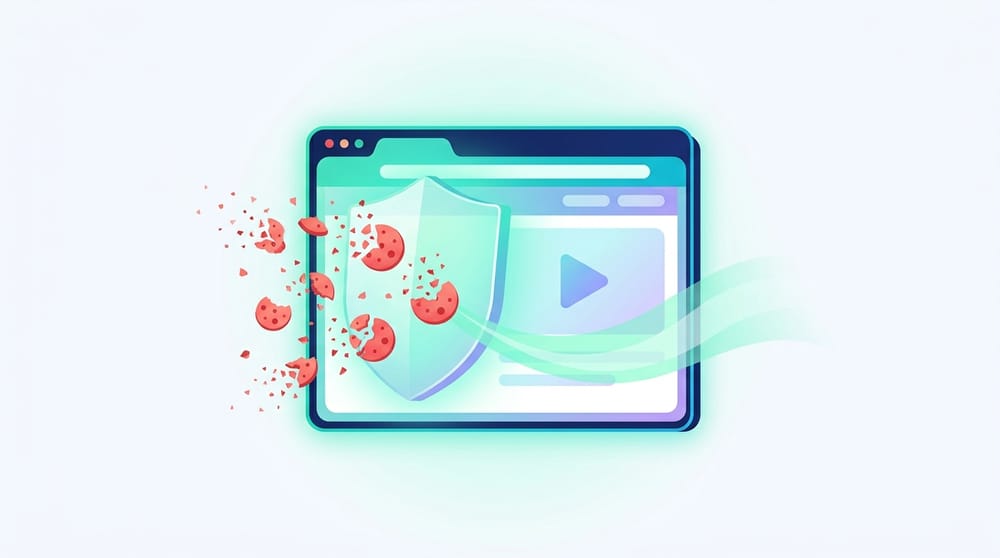
Online tracking follows you everywhere, but you do not have to accept it. If you want to know how to block cookies with a cookie blocker—without breaking your favorite websites—the formula is simple. First, disable third-party cookies in your browser settings. Second, leave first-party cookies alone so logins and shopping carts still work. Finally, add a dedicated cookie blocker extension to stop background tracking scripts.
For most people, the best setup is to block third-party cookies in your browser settings, keep first-party cookies enabled to preserve site functionality, and add a tracker blocker extension for a second layer of privacy. Chrome and Edge require manual changes, while Safari and Firefox restrict cross-site tracking by default.
Start Here: The Safest Default Setting
Start by blocking third-party cookies, which primarily consist of advertising and cross-site trackers. Keep necessary first-party cookies active so websites remember your login credentials, shopping carts, and security preferences.
Do not block every cookie by default. Research shows blanket first-party blocking causes major site breakage, particularly around sign-in and checkout flows.
Reality Check: You probably need to turn this on yourself. In 2024 and 2025, Google's Privacy Sandbox initiative went through a series of reversals: in July 2024 Google abandoned its plan to deprecate third-party cookies outright, in April 2025 it confirmed it would not introduce a standalone cookie consent prompt, and by October 2025 it officially retired the remaining Privacy Sandbox APIs. Third-party cookies remain active in Chrome by default unless you manually restrict them in your browser settings.
Blocking third-party storage preserves basic privacy. First-party cookies preserve site function. Blocking both guarantees broken pages.
Which Cookies Should You Actually Block?
Blocking cookies stops websites from saving new tracking data. Clearing cookies deletes data already stored on your device. For a clean slate, do both: block future tracking, then clear historical data.
Use this matrix to decide what stays and what goes:
| Category | What it does | Safe to block? | What breaks if blocked |
|---|---|---|---|
| Necessary | Core site function (logins, security) | No | You cannot log in or check out. |
| Functional | Remembers choices (language, region) | Usually no | Site resets to default settings every visit. |
| Analytics | Tracks how you use a specific site | Yes | Nothing visible to you. |
| Advertising / Tracking | Follows you across different websites | Yes | Ads become generic instead of personalized. |
COOKIEGRAPH research shows that blocking all cookies breaks the first-party data sites need for forms, payments, and saved settings. Start with third-party blocking only.
A Cookie Banner Blocker vs. A Tracking Blocker
A banner blocker hides or auto-dismisses cookie pop-ups. A tracking blocker intercepts ad scripts, pixels, and tracking elements before they load. They solve entirely different problems.
Fewer pop-ups do not equal less tracking. If your goal is fewer visual interruptions, a pop up blocker auto-dismisses overlays. If your goal is digital privacy, a tracking blocker targets the hidden third-party scripts operating in the background.
How to Block Third-Party Cookies in Your Browser
Chrome and Edge require manual intervention. Firefox and Safari mostly need verification.
Chrome on Desktop
- Open Settings > Privacy and security > Third-party cookies.
- Select Block third-party cookies.
- Leave the "related sites" exception alone unless a specific service you use spans multiple domains.
Chrome on Android
- Open Settings > Site settings > Third-party cookies.
- Choose Block third-party cookies.
Note: Standard Chrome mobile does not support Web Store extensions, making this native setting your primary defense.
Microsoft Edge
- Go to Settings > Privacy, search, and services > Cookies.
- Turn on Block third-party cookies.
- Ensure Tracking Prevention is set to Balanced. Microsoft defines this as blocking trackers from unvisited sites while keeping most pages working normally.
Firefox
Firefox ships with Enhanced Tracking Protection enabled in Standard mode. Mozilla includes Total Cookie Protection here by default, confining cookies to the site that created them. Move to Strict only if you accept higher site breakage.
Safari on Mac and iPhone
Apple enables baseline protection automatically. Verify your settings:
- Mac: Safari > Settings > Privacy > Ensure Prevent cross-site tracking is checked.
- iPhone/iPad: Settings > Apps > Safari > Ensure Prevent Cross-Site Tracking is toggled on.
Do not select "Block All Cookies" unless you accept heavy functionality loss.
Brave & Chromium Alternatives
Brave blocks trackers, cross-site cookies, and fingerprinting through its native Shields feature. On other Chromium browsers, apply the standard Chrome-style settings.
When to Add a Cookie Blocker Extension
Browser settings dictate whether a cookie can be stored on your hard drive. They do not prevent the browser from downloading the ad scripts, tracking pixels, or heavy overlays that clutter your screen.
A dedicated cookie blocker acts as a second defense layer. Add one if you want to filter out network requests for trackers before they even render.
The Manifest V3 Requirement
If you use Chrome, you must use a Manifest V3-native extension. Chrome's Manifest V2 phase-out began disabling older extensions in Chrome's stable channel from October 2024, with full support removal completing in Chrome 139 (mid-2025). Any tracking blocker you install today must comply with MV3 architecture to function.
Tools like Blockify filter ad-related network calls, media ad calls, and tracking elements before they load locally. It is not a replacement for native browser cookie settings, but rather a complementary layer that reduces third-party tracking scripts and ad pixels.
Use browser settings to stop cookie storage. Use Blockify for Chrome or Edge to stop tracking scripts and page clutter from loading in the first place.
What to Do When Blocking Cookies Breaks a Site
If a website fails to load, do not disable your global privacy protection. Instead, add a per-site exception. Common symptoms of over-blocking include broken "Continue with Google/Apple" buttons, missing checkout modules, or explicit "cookies required" errors.
The 3-Step Recovery Workflow
- Turn off cookie protection for that specific site only.
- Refresh the page and test the broken feature.
- If it works, keep the local exception and leave your global blocking active.
- Chrome fix: Add the URL to Allowed to use third-party cookies.
- Edge fix: Add a Cookies or Tracking Prevention exception for the URL.
- Firefox fix: Click the shield icon in the URL bar and disable protection for the site.
What Cookie Blocking Cannot Stop
Blocking third-party cookies is a strong baseline, but it does not guarantee total anonymity.
First, tracking frequently moves into first-party contexts. Many domains now run trackers directly through their own servers to bypass third-party restrictions. Second, advanced techniques like fingerprinting identify you based on your device hardware, screen resolution, and installed fonts—bypassing cookies entirely.
The Low-Breakage Addition: Global Privacy Control (GPC)
Global Privacy Control is a browser signal that legally tells websites you do not want your personal information sold or shared. It adds a low-friction privacy layer without breaking site functionality. Browsers like Brave and Firefox support GPC natively.
FAQ
Does Incognito mode block cookies?
Not permanently. Chrome blocks third-party cookies in Incognito by default, but its primary function is wiping your local browsing history when you close the window. It does not provide full anti-tracking protection during the active session.
Will clearing cookies log me out?
Yes. Deleting cookies wipes stored session data. You will be signed out of your accounts and lose saved site preferences (like dark mode or language settings).
Can I allow cookies for just one site?
Yes. Chrome, Edge, and Firefox all support site-level exceptions. This is the safest way to fix a broken login or payment flow without lowering your privacy settings across the entire browser.
Can a cookie blocker remove consent banners too?
Sometimes, but not reliably. Aggressive banner removal can interfere with site functionality. Treat banner cleanup (hiding UI overlays) and tracking reduction (blocking network requests) as related, but separate, tasks.
Does an extension replace browser cookie settings?
No. Browser settings dictate whether files are stored locally. Extensions reduce the inbound network requests for ad scripts and pixels. You need to configure both for comprehensive privacy.