
You want to know how to block ads fast.
To stop ads immediately, match your ad-blocking tool to the exact place the ads appear. Use a trusted browser extension for Chrome or Edge, a Safari content blocker for iPhone, Private DNS for Android apps, and platform-specific workarounds for YouTube or Spotify. Built-in browser settings help stop pop-ups, but they do not replace a dedicated ad blocker.
Ad blocking is no longer just about cleaning up your screen—it is a mandatory security layer. Recent industry reports indicate roughly 1 in every 78 ads carried risk. Beyond stopping malware, running an ad blocker saves heavy internet users an estimated 52 hours of load time and 80 GB of bandwidth a year.
Old advice claiming one tool fixes everything is outdated. To fix your problem, skip generic guides and jump straight to your specific device or browser below.
Start Here: Find the Right Fix in 10 Seconds
- The fastest fix depends on where the ads live.
- Identify whether ads appear in a web browser, inside a mobile app, or as fake system alerts.
- Click the matching scenario below to jump directly to the solution.
If ads appear only in web pages, use a browser-level blocker. If they flood your mobile apps, configure Private DNS. If you face constant redirect loops or fake virus warnings, you need to clean up notification spam and malware.
If the ads are only in your browser: Go straight to the Chrome, Edge, or iPhone browser sections.
If the ads open new tabs or fake alerts: You likely clicked "Allow" on a malicious website notification. Go to the pop-up cleanup section.
If the ads are inside apps and games: Browser extensions cannot filter traffic inside locked-down apps. Go to the turn off ads in apps section.
If the problem is YouTube or Spotify: Streaming media requires dedicated handling. Go directly to the YouTube or Spotify sections.
The 5 Ways to Block Ads, Ranked by Effectiveness
- Every method has hard limitations.
- Extensions dominate desktop browsing; DNS and Safari rules dominate mobile.
- Knowing what a tool cannot fix saves hours of frustrating troubleshooting.
There is no universal best method. About 32.5% of Americans use an ad blocker, but many run the wrong type for their problem.
1. Browser extensions
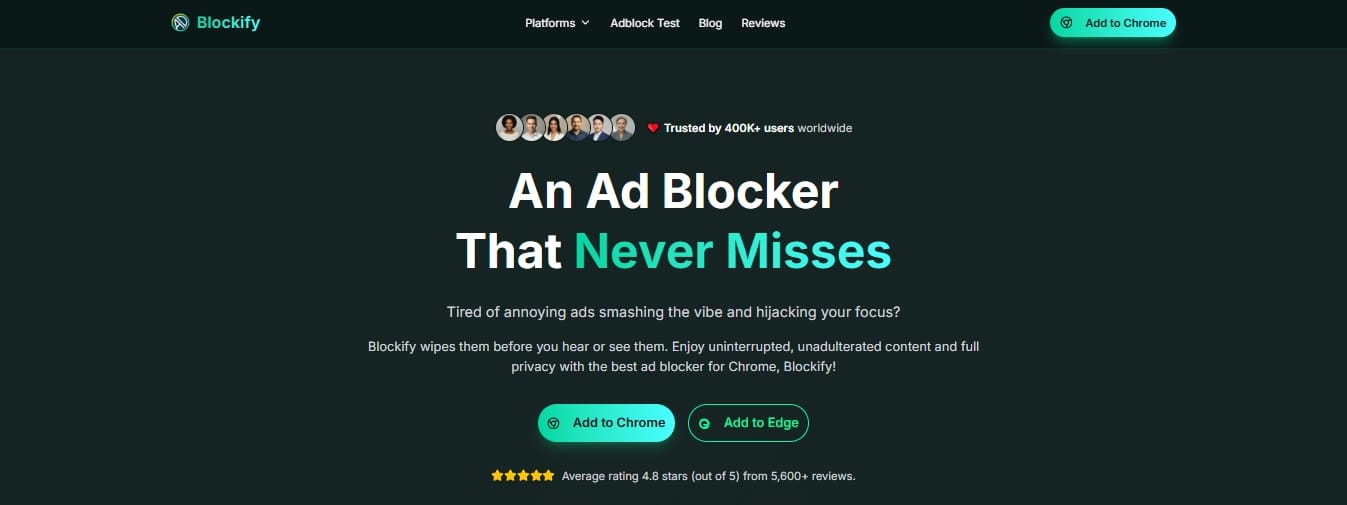
- Best for: Desktop browser ads, trackers, pop-ups, web-player media ads.
- Won't fix: Mobile apps, smart TV apps, creator-read sponsor segments.
- Cost: Free.
- Warning: Default "Acceptable Ads" settings in some popular extensions actually expose users to 13.6% more problematic ads than running no blocker at all. Always review filter settings.
2. Built-in browser settings
- Best for: Abusive pop-ups, misleading redirects, notification cleanup.
- Won't fix: Standard banners, video/audio ads, tracking scripts.
3. Private DNS
- Best for: Broad mobile coverage, ad-heavy mobile games.
- Won't fix: First-party ads where the app and the ad share the same server domain (like Facebook or the native YouTube app).
4. Switch browsers
- Best for: The fastest no-tinkering mobile route.
- Won't fix: Ads outside the browser.
- Note: Brave offers built-in blocking out of the box. Firefox for Android officially supports add-on installation.
5. Premium subscriptions
- Best for: Locked-down app ecosystems, smart TVs, native YouTube/Spotify apps.
- Won't fix: Cross-platform web browsing.
If you use a desktop browser and want the easiest fix right now, skip the tinkering and install Blockify for Chrome.
How to Block Ads on Chrome and Edge
- Chrome and Edge are the easiest surfaces to clean up.
- Built-in settings block abusive pop-ups, but not normal ads.
- For complete filtering, you must install a trusted extension.
How to Block Ads on Chrome Desktop
Chrome's native tools filter baseline abuse, but they do not replace a real ad blocker.
- Turn on Chrome's built-in pop-up blocker:
- Navigate to
chrome://settings/content/popups. - Select Don't allow sites to send pop-ups or use redirects.
- Go to
chrome://settings/content/intrusiveAds. - Select Block ads on sites that show intrusive or misleading ads.
- Navigate to
- Install a dedicated Chrome extension:
- Open the Chrome Web Store.
- Search for a trusted ad blocker.
- Click Add to Chrome and approve the permissions.
For a lightweight, privacy-first option built to handle media-heavy sites, start with Blockify for Chrome. It is free, maintains a 4.8-star rating across 5,600+ reviews, and specifically targets trackers, redirects, and audio/video ads without requiring manual filter configuration. The developer does not collect or sell your data.
Did Manifest V3 kill Chrome ad blockers?
No. Chrome recently updated its extension framework to Manifest V3 (MV3). While older legacy extensions were disabled, current MV3 blockers operate highly effectively.
A recent academic study found no statistically significant drop in overall blocking effectiveness for updated MV3 tools. Old advice telling you to install unsupported legacy tools is outdated. For a practical breakdown, see Does Chrome Manifest V3 Kill Ad Blockers?.
How to Block Ads on Microsoft Edge
Edge runs on the Chromium engine, meaning it fully supports Chrome extensions.
- Turn on pop-up blocking: Go to
edge://settings/content/popupsand toggle Block to on. - Increase tracking prevention: Go to
edge://settings/privacyand set Tracking prevention to Strict. - Install an extension: Visit the Edge Add-ons store or the Chrome Web Store to install Blockify for Edge.
How to Block Ads on My Phone (Android and iPhone)
- Phone ad blocking strictly depends on your operating system.
- Android offers broader system-level DNS options.
- iPhone filtering is highly effective inside Safari, but weak inside independent apps.
Desktop advice fails on mobile because standard mobile Chrome and Safari do not allow traditional PC extensions.
How do I block ads on Android mobile?
Standard mobile Chrome does not support extensions. To block web ads, switch to a browser with built-in blocking (like Brave) or one that supports add-ons (like Firefox for Android). To reduce ads inside mobile games and apps, configure a Private DNS via your network settings.
How to Block Ads on Android With DNS
Private DNS blocks requests at the network layer, preventing your phone from connecting to known ad servers. (support.google.com)
- Open Settings > Network & Internet.
- Tap Private DNS.
- Select Private DNS provider hostname.
- Enter a trusted DNS address (e.g.,
dns.adguard-dns.com) and tap Save.
Note: DNS cannot block same-domain ads. If an app serves content and ads from the identical server (like Instagram or YouTube), DNS cannot separate them without breaking the app. For the tradeoffs, read DNS ad blocking vs browser ad blocking. (getblockify.com)
How to Stop Pop-Up Ads on Android Phone
If random ads appear on your home screen or notification tray, they are not standard web ads. They are notification spam. (support.google.com)
- Open Chrome, tap Settings > Site Settings > Notifications.
- Turn off permissions for unfamiliar websites.
- If full-screen ads appear randomly, uninstall any recently downloaded flashlight, wallpaper, or utility apps—these often contain adware. (support.google.com)
How to Block Ads on iPhone
On iPhone, your best defense is Safari. Enable Safari's built-in pop-up blocker, download a third-party Safari content blocker from the App Store, and turn on the extension in your settings. This cleans up web browsing but will not stop ads inside independent apps like the native YouTube app or free iOS games.
- Turn on Safari pop-up blocking: Open Settings > Apps > Safari and toggle Block Pop-ups on.
- Turn on a Safari content blocker: Download a highly-rated content blocker from the App Store. Then, open Settings > Apps > Safari > Extensions and toggle it on.
- Use Distraction Control: On iOS 18 or later, tap the Page Menu icon in Safari's search bar and select Hide Distracting Items to manually erase static page clutter.
- Stop Apple ad tracking: Open Settings > Privacy & Security > Apple Advertising and toggle Personalized Ads off.
How to Block Ads on YouTube
- YouTube is the hardest mainstream target due to frequent anti-ad-block updates.
- Browser playback is much easier to clean up than the official mobile or smart TV apps.
Following massive crackdowns on ad blockers, YouTube ad-blocker demand spiked significantly. The platform frequently alters ad injection scripts to bypass standard filters.
How do I block ads on YouTube?
The most reliable free method is watching YouTube in a desktop or mobile browser equipped with an ad blocker, rather than using the official app. Desktop extensions (like Blockify) can intercept video ads, while mobile users can watch via Safari (with a content blocker) or Brave. Ads inside the native TV and mobile apps are incredibly difficult to block without YouTube Premium.
- Desktop: Rely on a robust extension built for media. Blockify reduces pre-rolls, mid-rolls, and overlays on the web player. Read more on the YouTube Ad Blocker page.
- Mobile Phone: Do not use the official app. Watch via Safari (iPhone) or Brave/Firefox (Android).
- Smart TVs: Network-level options like Pi-hole struggle because TV apps use same-domain ad serving. Premium is the lowest-maintenance solution here.
How to Block Spotify Ads
- Browser-based fixes are the cleanest free route.
- Extensions cannot reach inside the native desktop or mobile app.
How do I block Spotify ads?
Spotify is easiest to clean up in the web player. By listening through Chrome or Edge and installing a dedicated browser extension, you can block audio ads, banners, and trackers. If you strictly use the native iOS, Android, or desktop app, browser extensions cannot help, making Spotify Premium the simplest option.
Browser tools govern web code. They cannot rewrite the compiled code of the Spotify native applications. If you listen via a Chromium browser, installing Spotify Ad Blocker explicitly blocks audio interruptions during playback.
How to Remove Ads From Apps Permanently
- "Permanent removal" is not a realistic promise for every single app.
- System-wide blocking reduces network-level ads but fails against baked-in platform ads.
How to remove ads from apps permanently?
You cannot eliminate every ad in every app forever. System-wide tools like Android Private DNS or network-wide Pi-hole setups block known ad domains, vastly reducing ads in mobile games and utility apps. However, first-party ads (like sponsored Amazon products or native social media feeds) cannot be blocked without breaking the app itself.
Accept the hard limits of network blocking. Use DNS for mobile games, switch to ad-free premium tiers for locked-down social apps, and rely on Blockify for Chrome for cross-device web browsing.
Stay Safe: How to Spot a Fake Ad Blocker
- The wrong blocker introduces malware instead of removing it.
- Always install from official stores and review permission requests.
To ensure your ad blocker is safe, stick strictly to the Chrome Web Store, Edge Add-ons, or Apple App Store. Do not sideload tools from random forum links.
Red Flags to Watch For:
- Vague developer identities or no clear privacy policy.
- Requests to disable your existing antivirus software.
- Permissions asking to manage downloads or read data on irrelevant sites.
Always tie permission prompts to common sense. Ensure you download the official Blockify for Chrome listing.
If You Still See Ads, Troubleshoot in This Order
- Do not switch tools immediately if an ad slips through.
- Check for extension conflicts or stale cache first.
If ads suddenly reappear, usually one of four things happened: your blocker needs an update, another extension is conflicting with it, the ad is inside a locked-down app, or the site changed its delivery code. (getblockify.com)
- Update your browser and blocker.
- Disable conflicting extensions. Running two ad blockers simultaneously breaks their filtering rules.
- Clear your cache and reload. Stale cache serves old ad scripts.
- Diagnose the ad surface. If the ad is baked into a podcast read or a first-party social feed, your blocker is not failing—it is just outside its jurisdiction.
- Run a test. Use an Ad Block Test to verify baseline functionality. For deeper technical insights, read our Ad Block Detection & Bypass Methods guide.
Frequently Asked Questions
Are ad blockers legal?
Yes. Using an ad blocker is widely considered legal because it merely changes how your own browser renders public web code. However, websites are also legally permitted to deny you access or restrict video playback if they detect you are using one.
What happened to uBlock Origin on Chrome?
Chrome's Manifest V3 update disabled several older extensions, pushing users toward supported, updated alternatives. Legacy advice to install older tools is no longer accurate for standard Chrome users. Firefox, however, maintains broader support for legacy extension frameworks. For the full background, see Why uBlock Origin Was Removed from Chrome?.
Do ad blockers slow down your browser?
No. By preventing heavy video ads, tracking scripts, and high-resolution banners from loading, ad blockers drastically reduce page weight. The normal outcome is a significantly faster, less resource-intensive browsing experience.
Can ad blockers protect me from viruses?
They reduce exposure to malvertising, but they are not full antivirus software. Threat reports continuously highlight risky ads on mainstream sites, making ad blocking a crucial first line of defense. However, you still need secure browsing habits and operating system updates.
What's the difference between an ad blocker and a pop-up blocker?
A pop-up blocker only stops new windows or tabs from opening automatically. A full ad blocker filters banners, video ads, audio ads, tracking scripts, and overlays while the page renders. Pop-up blockers solve only a fraction of the problem.
Can ad blockers work on smart TVs?
Sometimes, but not like browser extensions do. TVs and streaming boxes require network-level filtering (like modifying router DNS) or platform-specific paid tiers. They are heavily locked-down environments, making free ad blocking difficult and device-specific.